
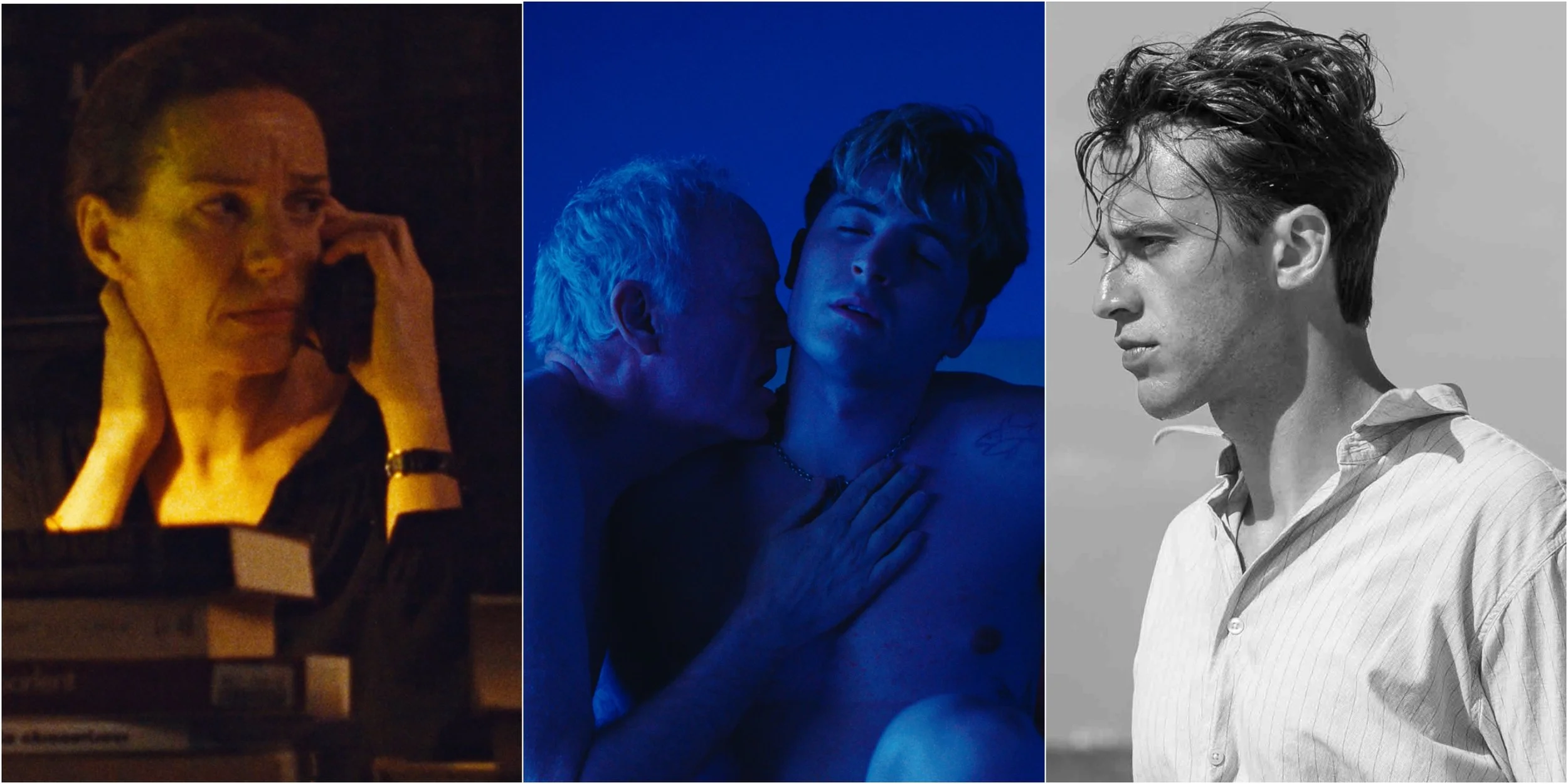
‘Chronovisor’ (Grasshopper Film, ‘Blue Film’ (Obscured Releasing), ‘The Stranger’ (Music Box Films)
2026 has marked a fantastic year for the global box office, with huge studio projects like The Odyssey and Spider-Man: Brand New Day amassing record-breaking grosses, and the horror genre also generating wild success with the unlikely breakouts of both Obsession and Backrooms, supported by a younger fanbase that has turned out to be one of the biggest devotees of the theatrical experience in a post-COVID world.
But what about the impressive, albeit smaller-scale independent or international films that audiences may have overlooked this year? There have been plenty to choose from, even if they have not had the splashiest rollouts or notable red-carpet stars to promote them, and Foremost Film is here to bring some of the year’s most notable under-the-radar cinematic gems to your attention, just in time for the long holiday weekend! Continue reading to check out 10 underrated movies from 2026 we recommend adding to your watchlist before the year comes to a close.
‘Blue Film’
Directed by: Elliot Tuttle
With his feature debut, Tuttle channels some of the boldest provocateurs of European cinema to deliver a work hellbent on excavating the moral and sexual boundaries of queerness in ways rarely seen onscreen, culminating in a film both viscerally demanding and endlessly engrossing in its ideas.
British hunk Kieron Moore stars as ‘’Aaron Eagle,’’ a WeHo camboy who is offered $50,000 to spend the night with an anonymous fan who turns out to be… His former 7th-grade English teacher, Mr. Grant (Reed Birney). As the shock of this revelation fades, Blue Film settles into its unique rhythms, which always burn with provocation despite the narrative unraveling in a single location between just two characters. Blue Film focuses on the unfolding of this unlikely rekindled connection; we come to understand the inner workings of these two vastly different Queer characters, the impulses that drive them, and the memories that haunt them. Buy or rent Blue Film.
‘Chronovisor’
Directed by: Jack Auen and Kevin Walker
Simultaneously an atmospheric tribute to dark academia and an unsettling Vatican conspiracy thriller, Chronovisor is a wholly distinctive work and likely one of 2026’s most bewitching movies. Just the feature debut of its co-directors, Chronovisor exhumes an unexplained, largely unknown phenomenon from the past and uses it to explore humanity’s endless fixation on understanding the relationship between the seen and unseen world.
Real-life academic Anne-Laure Sellier stars as the movie’s central character, Béatrice, a professor and scholar of philosophy and neuroscience who becomes obsessed with the chronovisor, a machine said to capture sounds and images from the past and display them as holograms in the present. As beguiling and unnerving as the classical score that punctuates the arcane mystery at its core, Chronovisor’s foundation in real people and (possibly?) real happenings readily makes for a rabbit-hole conspiracy with bona fide credits that will surely haunt viewers enough to make it not only a critical favorite, but maybe even a cult classic in the making. Find Chronovisor showtimes.
‘Dreams’
Directed by: Michel Franco
Totally inconsolable in its views of today’s America and the crises playing out at its southern border, Dreams is a steely, fascinating story of cross-cultural lovers doomed from the start, starring Jessica Chastain and dancer-turned-actor Isaac Hernández. Chastain plays Jennifer, an uber-rich patron of the arts who falls for the much younger Fernando (Hernández), who longs to leave Mexico for the United States to become a principal ballet dancer.
Jennifer prefers to keep Fernando to herself, avoiding run-ins with her bougie circle of associates and family members when she is with her beloved, which Fernando becomes increasingly bothered by, with plenty of reason. When they have chance encounters with her cohorts, Jennifer never introduces him as her boyfriend, but instead as a dance teacher at her institution. As Fernando becomes increasingly disillusioned by the facade of their relationship, Jennifer leans in even more, pulling out all the stops as he fades from her life to focus on his own future in the United States: a toxic cycle of authority over Fernando rises to the surface. The actors collaborate onscreen with poisonous chemistry, oscillating from steamy sexual encounters to incredible ruthlessness, devoid of all tenderness, a primary feature of Franco’s modus operandi. Dreams is a film that will absolutely sear into your brain. Buy or rent Dreams.
‘Islands’
Directed by: Jan-Ole Gerster
There is certainly trouble in paradise in Islands, a sun-baked slow burner that gradually descends into neo-noir territory as its characters fall deeper into their respective existential quandaries. The latest work from German filmmaker Gerster, marking his debut English-language feature, Islands flaunts a cast of arthouse favorites, including Sam Riley, Stacy Martin, and Jack Farthing, whose compelling performances reinforce an intricate central mystery that beguilingly refuses to concede its hiddenmost secrets.
Riley stars as Tom, a tennis pro turned instructor at a nondescript resort on the Canary Island of Fuerteventura. Tom’s binge partying and eternal ennui are broken one day when a young family arrives at the resort for a “much-needed” vacation. Anne (Martin, transforming her typical dark locks into those of a Hitchcock blonde) asks Tom to teach her son, Anton, tennis; she is even willing to pay double his usual rate. As Tom begins to notice the deep bond between mother and son, the illusion is shattered by the sharp arrival of Dave (Farthing), Anton’s father and Anne’s husband, respectively. Do not let the picturesque beaches and pristine tennis courts of its amazing setting fool you, for Islands works as a bleak and twisty inspection of a man in crisis, frozen by inhibitions that threaten to swallow him whole. Rent or buy Islands.
‘Living the Land’
Directed by: Huo Meng
While Living the Land concentrates on four generations of a farming family in a tiny Chinese hamlet still largely dictated by tradition, its filmmaker chooses to focus most profoundly on the perspective of one of the clan’s youngest members, a ten-year-old boy, Chuang (Wang Shang), through whom the audience experiences the slowness of time that occurs during childhood when processing new information into lasting memories. Roughly spanning a year in the small village during the 1990s, as traditional farming practices give way to free-market economics, Living the Land richly examines this period of metamorphosis and its lasting effects on the young protagonist and his family.
Despite its emotionally charged chronology of peasant hardship as seen through the eyes of a child, Living the Land feels like a work with such immense reverence for the people and stories that inspired it, an increasingly crucial vision as rural communities worldwide are challenged by the unceasing development of technology and the demise of traditional practices. Visually stunning with dynamic characters who will pluck your heartstrings, Living the Land stands out among the very best films of 2026. Buy or rent Living the Land.
‘Mārama’
Directed by: Taratoa Stappard
Doppelgangers, locked doors, family secrets galore: Mārama, the uniquely atmospheric debut feature from Māori-English filmmaker Stappard, draws on Gothic horror elements to fiercely rebuke the colonial influences that decimated the Indigenous peoples of Aotearoa New Zealand, serving as a singular genre piece grounded in anticolonial philosophy.
Māori actress Ariāna Osborne stars as Mary Stevens, a young woman who travels from New Zealand to England circa 1860 after receiving a cryptic letter that promises details about the family she never knew, only to end up employed by a wealthy landowner, played by Toby Stephens, whose fetishistic fascination with Māori culture is a red flag from the jump. Inspired by the wāhine toa, the powerful Māori women who shaped his cultural heritage, Stappard uses Mārama as a mouthpiece for the subdued women at the heart of its story, figures of limited autonomy in its Victorian setting. Stream Mārama on Shudder.
‘Romería’
Directed by: Carla Simón
As captivating and nuanced as the Galician coastline where it is set, Romería offers thoughtful insight into its director’s complicated relationship with her distant relatives after losing both parents at an early age.
Serving as a stand-in for Simón and the film’s core is Marina Piñeiro (the fresh-faced Llúcia García in her first acting role), an eighteen-year-old who aspires to study cinema in Barcelona circa 2004. Trapped in a cycle of university bureaucracy, Marina learns she must obtain the signatures of her paternal grandparents, whom she has never met after being put up for adoption as an infant, to qualify for the scholarship she needs. With a modest camcorder in tow, Marina embarks on a ferry journey from mainland Spain to the scenic Atlantic Ocean vistas of Vigo, where she plans to meet her father’s family for the first time. An elegant meditation on memory, place, and the challenges of family relations, Romería is an unparalleled, sun-soaked coming-of-age movie that is deeply connected to its auteur. Stream Romería on The Criterion Channel.
‘The Blue Trail’
Directed by: Gabriel Mascaro
Mascaro's latest vision takes audiences on a hypnotic, hilarious, genre-bending journey down the Amazon River while also delivering sharp criticisms of contemporary Capitalism and ageism.
Starring Denise Weinberg as Tereza, The Blue Trail constructs a not-so-distant future for Brazil where the older generations are hauled off to a specialized colony to live out their final days in peace, as mandated by an unseen authoritarian government that treats aging as a potential source of economic stagnation. Avoiding such a fate at all costs, the movie tracks Tereza as she dodges the authorities, makes unlikely friends, and encounters a snail with psychedelic capabilities. These obstacles only strengthen the newness of living for Tereza, despite her advancing years and increasing marginalization. The Blue Trail is a beautiful, offbeat film and another triumph for Mascaro, one of Brazil’s most fascinating contemporary filmmakers. Buy or rent The Blue Trail.
‘The School Duel’
Directed by: Todd Wiseman Jr.
The School Duel delivers an unapologetically in-your-face condemnation of pro-gun politics and the nationalist sentiments that support them, culminating in a stylish, gutsy film that often startles with how closely its satirical vision resembles the Trumpian America we are increasingly confronted with.
In many ways, The School Duel’s central character, thirteen-year-old Sammy (Kue Lawrence), is an ordinary American boy: he is bullied at school, raised by a single mother, and loves playing video games. Yet, Sammy is coming of age during extraordinary times, specifically in a near-future “Free State of Florida”, where gun control has been completely outlawed under a radically conservative governor, played by Oscar Nuñez. With the abolition of gun laws, school shootings are at an all-time high, and Florida’s overseers have implemented an annual “School Duel,” a nationally televised fight-to-the-death in which high-risk students from across the state are chosen to represent their respective schools, a way of allegedly quelling the shooting incidents and serving as a major propaganda ploy.
Opening with a quote from A Modest Proposal, The School Duel’s central ideas offer a modern, eerily timely reinterpretation of the classic text, functioning as a bold satire that warns of the times ahead and what they could hold for future generations. Wiseman’s debut channels The Hunger Games through the worsening frictions of the American zeitgeist, culminating in a fearlessly ambitious thriller with a singular statement. Buy or rent The School Duel, or watch it for free with a Kanopy account.
‘The Stranger’
Directed by: François Ozon
Ozon’s latest throws his hat into the ring of the few who have toiled to translate Albert Camus’ words into cinema, taking on the late intellectual’s arguably most famous work, first published in 1942. Elegantly shot in crisp monochrome and starring Benjamin Voisin as the epochal antihero at the novel’s center, Ozon’s effort is a sensual adaptation that may surprise some of the director’s longtime fans with its willingness to play by the rules laid down by its source material.
Working with frequent collaborator Manu Dacosse to construct the movie’s visual language, The Stranger’s cinematography does much of the heavy lifting in recreating the tangible atmosphere of Camus’ novel. Early scenes are awash in the blinding rays of the summer sun, with the camera seductively accentuating every droplet of sweat or ocean water clinging to the clavicles of the movie’s attractive cast, sketching them as the beautiful figures who epitomize the eternal chicness of French cinema and call back to the sensuous style that first put Ozon’s cinema du corps on the map. Although The Stranger may feel more buttoned-up than some of Ozon’s earlier works, the film still drips with an ominous carnality that makes its beautifully composed scenes and even more enchanting central character sear into your brain, much like its source material.