
‘Blue Film’ Review: An L.A. Camboy Gets a Blast From the Past in Elliot Tuttle’s Intense Queer Chamber Drama
Obscured Releasing
In the Western World, few words sear with the same vicious sting as “pervert” or “perversion.” While the Webster-Merriam Dictionary merely defines perversion as “a sinking to a state of low moral standards and behavior,” few would argue the word’s distinguishing association with criminal sexual acts, marking out those branded as “perverted” as some of the most harshly condemned by societies.
Blue Film, the striking feature debut from writer-director Elliot Tuttle, audaciously explores concepts of perversion unlike any other film of recent memory. Tuttle channels some of the boldest provocateurs of European cinema to deliver a work hellbent on excavating the moral and sexual boundaries of queerness in ways rarely seen onscreen, culminating in a film both viscerally demanding and endlessly engrossing in its ideas.
In one of its strongest nods to the racy works inspiring its title, Blue Film opens to glitchy webcam footage, in which gay camboy Aaron Eagle (British boxer-turned-actor Kieron Moore) has just started a live show for his devoted followers, who he proudly refers to as his “faggots.” Freshly returned from the gym, equipped with blonde highlights and a silver chain around his neck that would allow him to fit into any gay bar in West Hollywood, Aaron shows off the sweaty pubes poking out from his tighty-whities and the tattoos covering most of his body. Through the forceful, demeaning language he uses on the livestream, it is clear that Aaron has built his camboy career around dominating his followers with an alpha persona, even mentioning an upcoming gig in which one of them will pay him $50,000 for a night of the pleasures he can provide.
Aaron arrives at the predetermined rendezvous point with his client, a nondescript Airbnb in Los Angeles’ Hancock Park neighborhood. His customer seems tentative at first, even protecting his identity by wearing a face covering balaclava, a nervousness that Aaron responds to by domineeringly stripping down to his underwear once more, remarking, “If you looked like me, you’d wanna be naked all the time.”
Despite the titillating form that Aaron carves out, casually vaping away on the couch, his client seems reticent to jump into anything physical right away, instead probing Aaron about his personal history. Somehow, something feels off: this mystery man seems to know too much about Aaron, able to easily read through the lies he formed about his background, even pointing out that his real name is Alex — Not Aaron. Increasingly perturbed, Aaron, now Alex, rips away the customer’s mask to shockingly reveal a blast from the past: his 7th-grade English teacher, Mr. Grant (Reed Birney).
The last Alex had heard of the sixty-something Mr. Grant, first name Hank, he had been convicted back in their hometown in Maine for attempting to sexually assault one of his students, a punishment for which he received a lengthy prison sentence and the death of his teaching career, obviously. While Alex had spent the last decade-plus driving his adult aspirations into the ground on the gay circuit, Hank had been constantly thinking of Alex, whom he confesses he has had an attraction to ever since he had taught him, a magnetism that led him to empty his bank account for one night with the boy he has loved for so long.
Obscured Releasing
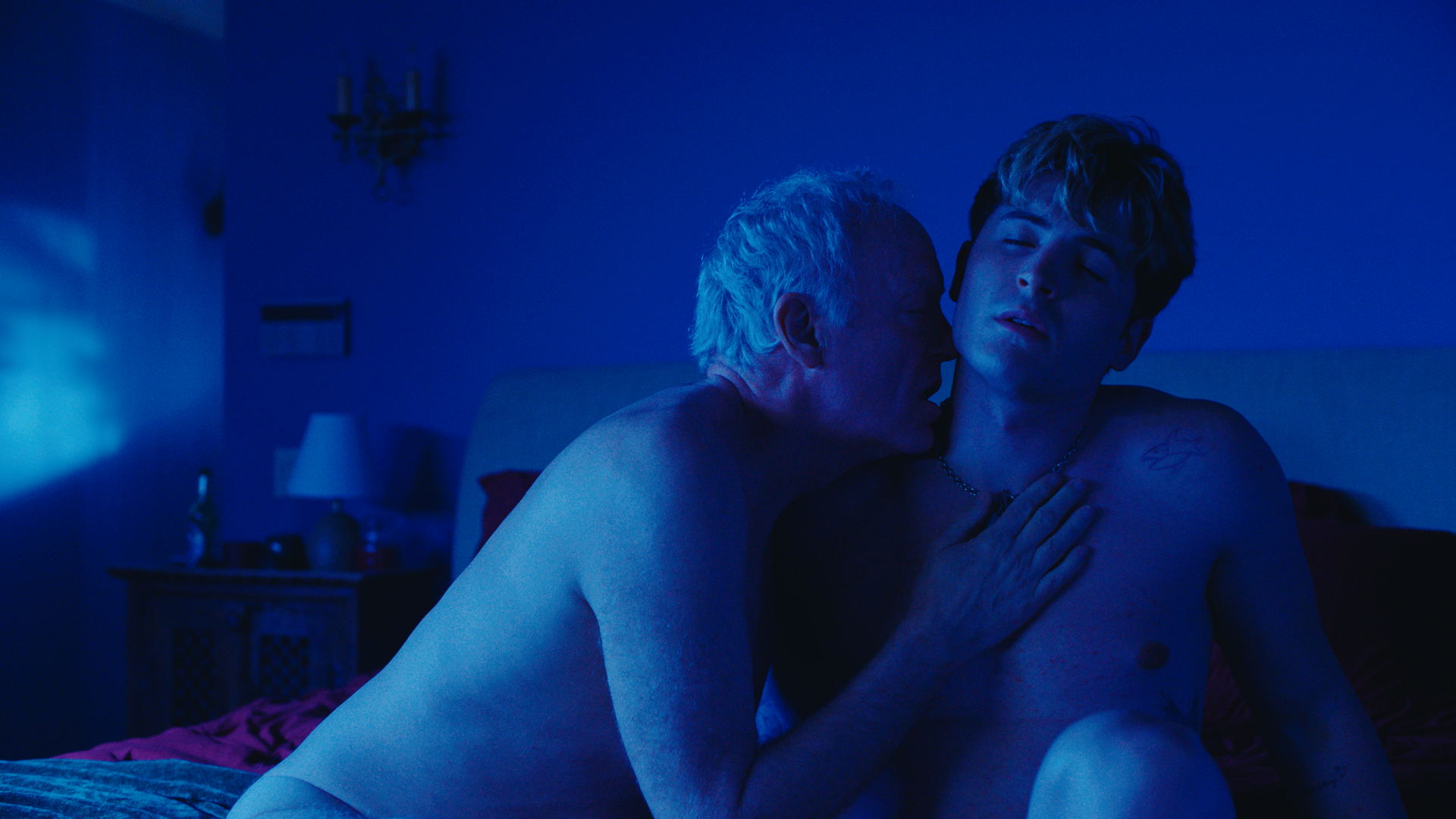
As the shock of Hank’s unveiling fades, Blue Film settles into its unique rhythms, which always burn with provocation despite the narrative unraveling in a single location between only two characters. Instead of being repelled by his former teacher’s appearance, Alex is almost attracted by the closeness, and the two dive into wide-ranging conversations from the empowerments of perversion they have experienced to the profound loneliness it has brought them, with the dialogue penned by Tuttle drawing the audience closer to the moral complexities of their feelings and beliefs.
Necessitated by such a script-driven story, Moore and Birney respectively tackle their nuanced characters with resonant dexterity, with the latter likely drawing on his theater experience to bring his challenging character to life. As the men’s meet-up draws them deeper into the stillness of the night, their dynamic breaks apart, comes back together, and switches roles in myriad ways, speaking to the roles of submission and domination they assume at any given moment as their exchanges intensify.
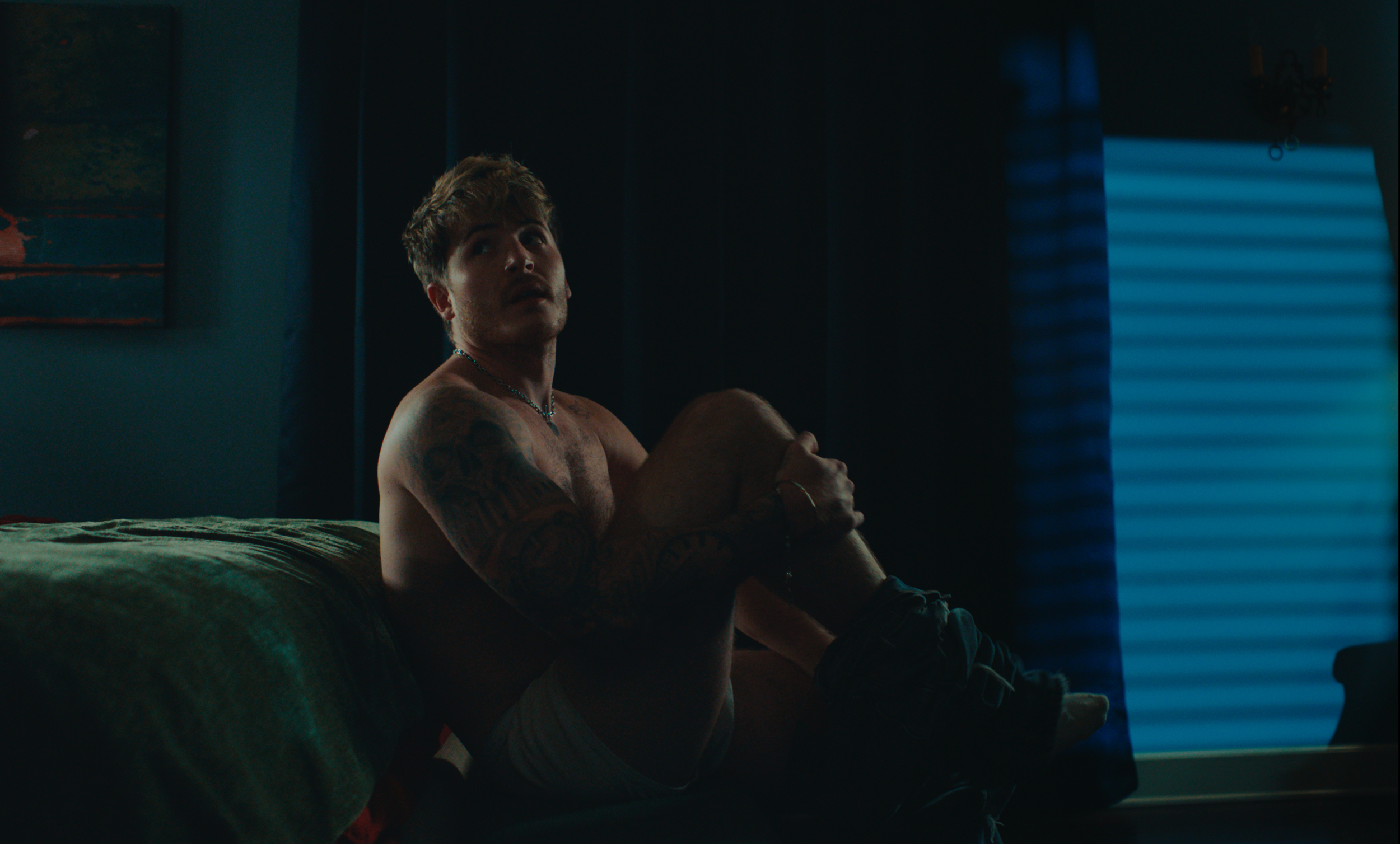
As Blue Film focuses on the unfolding of this unlikely rekindled connection, we come to understand the inner workings of these two vastly different Queer characters, the impulses that drive them, and the memories that haunt them. Although Alex’s character is introduced as a somewhat typically vain hypermasculine figure, Moore’s performance gradually reveals the cracks in his handsome facade. Initially fueled by the inverse parasocial relationship he has with his fans as “Aaron Eagle” and the power the persona gives him, both sexually and in terms of his self-esteem, Alex embodies a shallow facet of contemporary Queer culture that feels particularly relevant within the context of a social media-driven world: “My dick doesn’t have any feelings or thoughts or attitudes about sex.” Eventually lowering his walls with Hank, Alex comes to reflect on the emptiness such attitudes have instilled in him, the endless regrets they have spawned within his mind, only to be quieted with the aid of weed or booze.
Obscured Releasing
Although facing disparate circumstances, Hank mirrors Alex through his solemn isolation and at times contradictory feelings, existing on the farthest margins of an already marginalized community. While Alex’s perversions manifest outwardly through his camboy career, Hank’s require a repression that almost makes him more omnipresently aware of them, even compelled to turn to the church after his prison sentence in search of meaning or repentance. At one point, telling Alex, “I’ve always known it was wrong,” Hank cannot help but paradoxically fall into an alarming state of regard for his conundrum, citing historical references to pederasty in ancient Rome and using his academic background to attempt to explain or rationalize his desires.
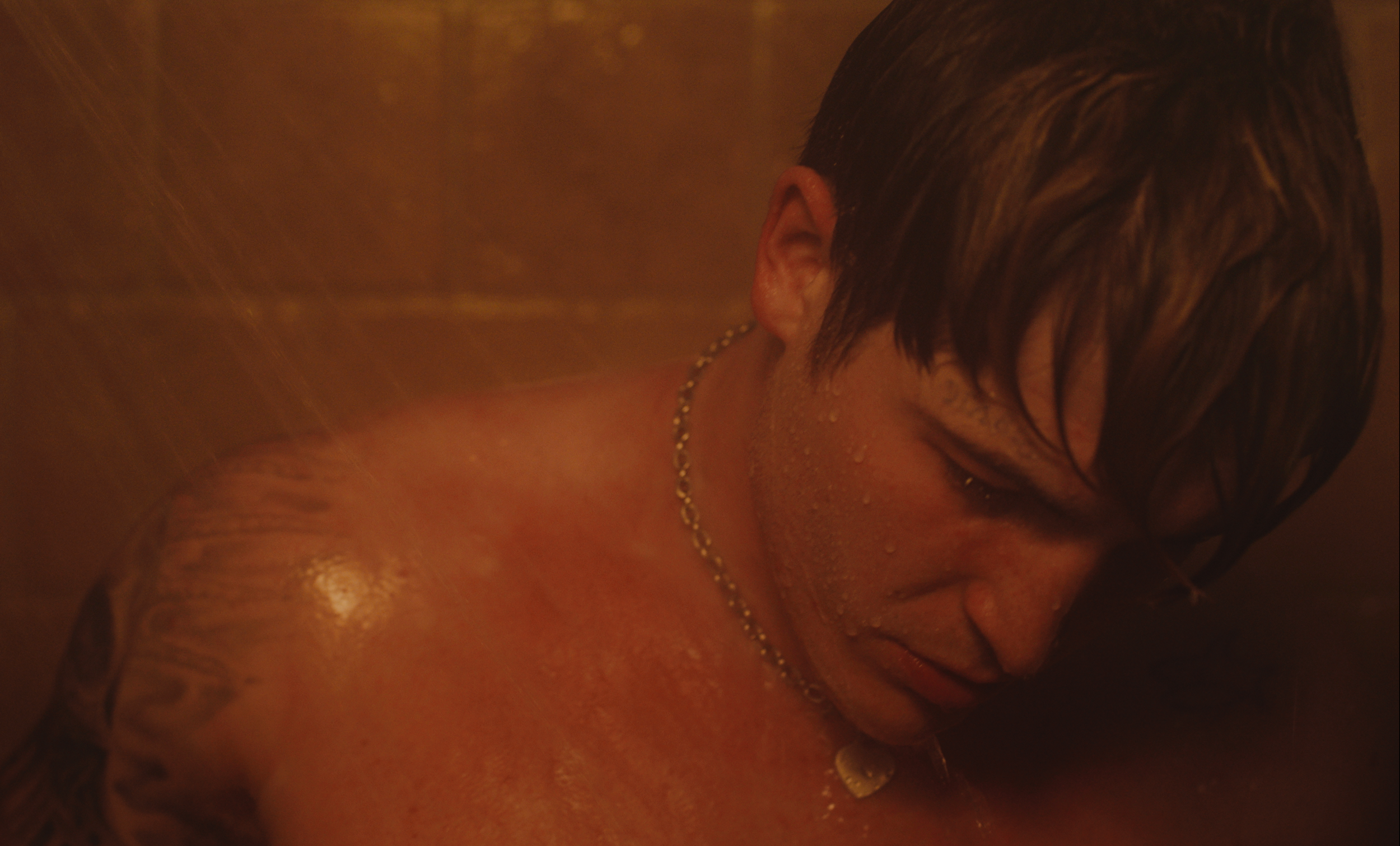
As Blue Film circles its two convoluted characters and their increasingly weighty exchanges, Tuttle and his team take moments to infuse the material with a certain levity that breaks up the intensity of their recollections. Cinematographer Ryan Jackson-Healy works around the film’s meager budget (shot over just twelve days) and single shooting location to instill a moody atmosphere in each scene, often employing lighting that ranges from vibrant blues and oranges to deep shadows to imbue every interaction with graphic allure. Furthermore, the camera almost exclusively uses medium shots and extreme close-ups to capture the men's connection as it blossoms, wilts, and blossoms again. One of these scenes that works in close-up shows Hank shaving Alex’s entire body to better fulfill the fantasy he is looking to explore, a striking moment as simultaneously intimate and uncomfortable as the narrative that surrounds it.
Just as the overblown mainstream appeal of Heated Rivalry threatens to consume all other Queer storylines within the media landscape, Tuttle’s debut arrives to blow the former out of the water through its layered complexities, which have already caused quite the stir following the movie’s film festival debut last summer at Edinburgh Film Festival. Tapping into the director’s affection for boundary-pushing auteurs like Catherine Breillat and Lars von Trier, Blue Film thoughtfully communicates with the challenges of the Queer experience through a subversive lexicon unparalleled in the landscape of contemporary American independent cinema.
4/5
U.S.A | 2025 | 85 Minutes | English | Color
‘Blue Film’ begins its U.S. theatrical release on Friday, May 9, courtesy of Obscured Releasing. Click here to find ‘Blue Film’ showtimes near you.