
‘The Most Precious of Cargoes’ Review: Michel Hazanavicius’ Personal, at Times Profound Animated Feature Debut

Distrib Films US
Screwball comedies, zombie flicks, and Academy Award Best Picture winners mark Michel Hazanavicius’ eclectic body of work, reflecting the French filmmaker’s bold penchant for genre cinema and his ability to investigate new ideas with fresh approaches. The Most Precious of Cargoes, Hazanavicius’ latest, is possibly his most personal and tender film to date while also serving as a major departure from his previous work thanks to its animation, a medium never before explored by the director.
Narrated by French film icon Jean-Louis Trintignant in his final role before his 2022 passing, The Most Precious of Cargoes is adapted from a 2019 novel of the same name, with a screenplay co-written by Hazanavicius and the book's author, Jean-Claude Grumberg, conveniently the director’s longtime family friend. Constructed under the guise of a familiar fairy-tale framework, the movie gradually reveals itself as a bleak yet ultimately optimistic portrait of an unlikely group forever altered by the benevolence they cling to despite the tragic state of the crumbling world around them.
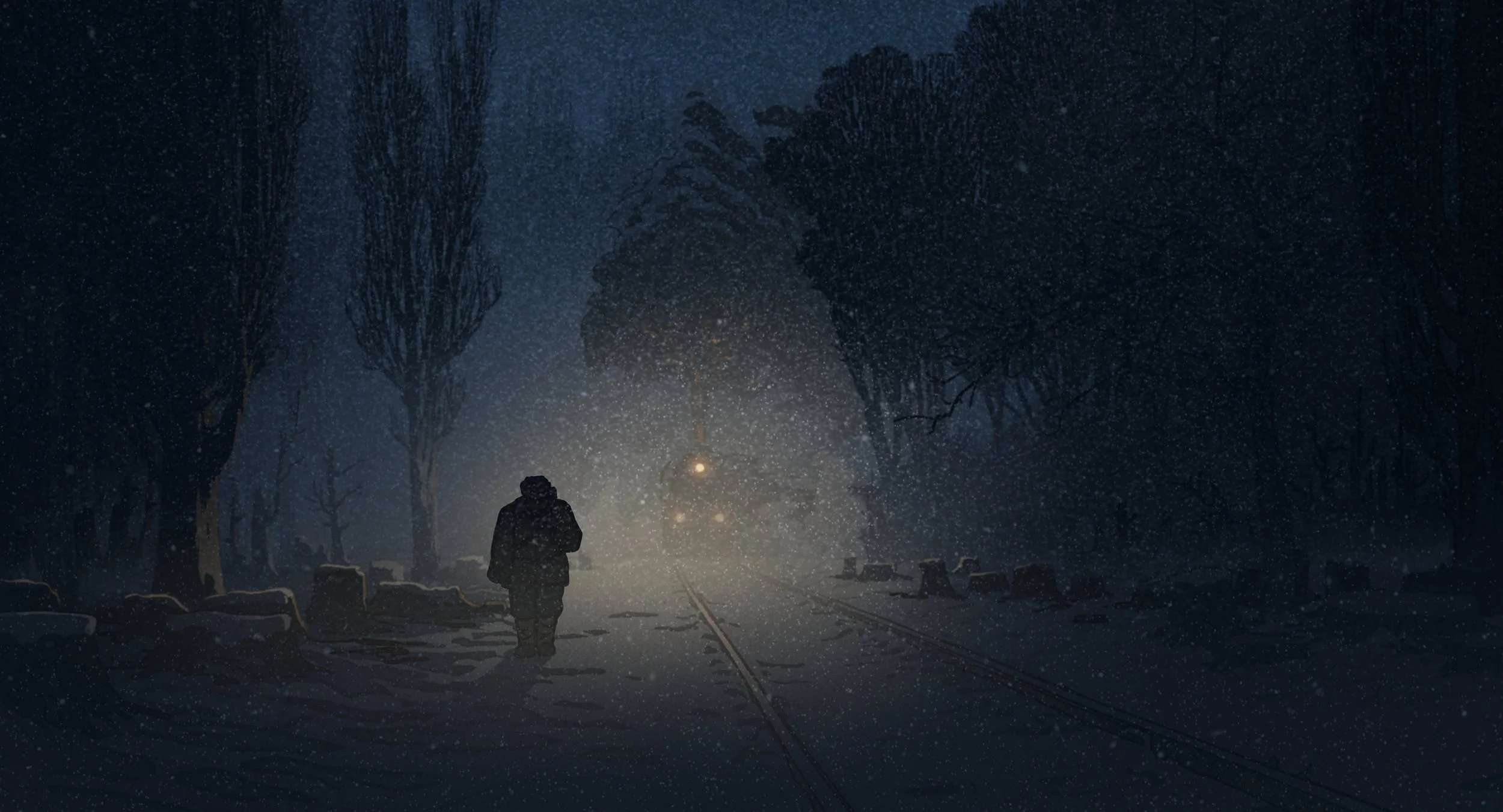
The film’s initial focus is on a nameless, unhappy woodcutter and his wife, who live a lonely life plagued by infertility and poverty deep within the hinterlands of Poland circa 1943. The silent repetition of the couple’s days is broken only by the mysterious trains that speed through the surrounding region, to which the woodcutter’s wife prays for some sort of salvation from the shabby mundanity she has come to know. The “Gods of the train” eventually answer her invocations when a baby is flung from its interiors into the snowy fields that surround the tracks. Rescuing the child from certain death, the wife decides to raise the enfant as her own.
Distrib Films US
Wrapped in a gold-threaded Tallit, or Jewish prayer cloth, the innocence of the baby girl is not lost on the wife; however, her husband’s opinions drastically differ: “She’s one of the heartless,” referring to the child’s Jewish heritage and reflecting the vehement antisemitism practiced by himself and his woodcutter colleagues. This makes no difference to the wife, who bears it as her calling to protect the harmless enfant at all costs. As time passes and the winter snows melt, revealing the verdant greens of the woodland, the husband’s heart similarly begins to thaw, and he comes to understand the error in his judgment.
While the woodcutter’s family life begins to flourish, The Most Precious of Cargoes leads its characters to wonder about their new daughter’s journey to them and the dire conditions that would lead a parent to make such a choice, a juncture in which the film’s fable-like account turns more directly to face the horrors of World War II and the Holocaust, leading its audience from the santity of the forests into the heart of Auschwitz itself.
Through The Most Precious of Cargoes, Hazanavicius, whose ancestry includes Lithuanian Jews, explores a facet of his personal history in ways his work rarely probes. In a contemporary landscape where Holocaust cinema often runs the risk of glibness or oversimplification, particularly as the generations who witnessed the historical event die off, Hazanavicius’ choice to animate the film sets it apart from other similarly heartwarming examples within the subgenre. The movie’s narrative split between the persecution of the Jews and the efforts of the “Righteous Among the Nations” further emphasizes the comprehensive chaos and devastation caused by the Holocaust with a specific universality that circles back to its parable-esque framework.

Distrib Films US
Regularly working as an editor and producer on many of his projects, The Most Precious of Cargoes serves as Hazanavicius’ first time working as an animator, hand-drawing each of the movie’s characters himself. The visual language of the film likely serves as its most striking asset, beginning with stunning watercolor-like vistas of the natural world before transitioning into nightmarish expressionist images that evoke the intense anguish of the film’s heroes.
While the early narrative peaks and valleys that distinguish the first half of The Most Precious of Cargoes eventually stall, resulting in a rather slogging latter section, Hazanavicius’ overall efforts culminate in an innovative work that effectively conveys its hopeful message. The Most Precious of Cargoes never feels redundant through its ideas, instead vital as the Holocaust fades with the memories of the departing generations over eighty years on.
3.5/5
France | 2024 | 81 Minutes | Color Animation | French with English Subtitles
‘The Most Precious of Cargoes’ had its world premiere at the 2024 Cannes Film Festival, where it competed for the Palme d’Or. The movie will be avaliable on DVD in the U.S. on Tuesday, June 23, courtesy of Distrib Films US.