
Foremost Film’s Favorite Movies of 2025
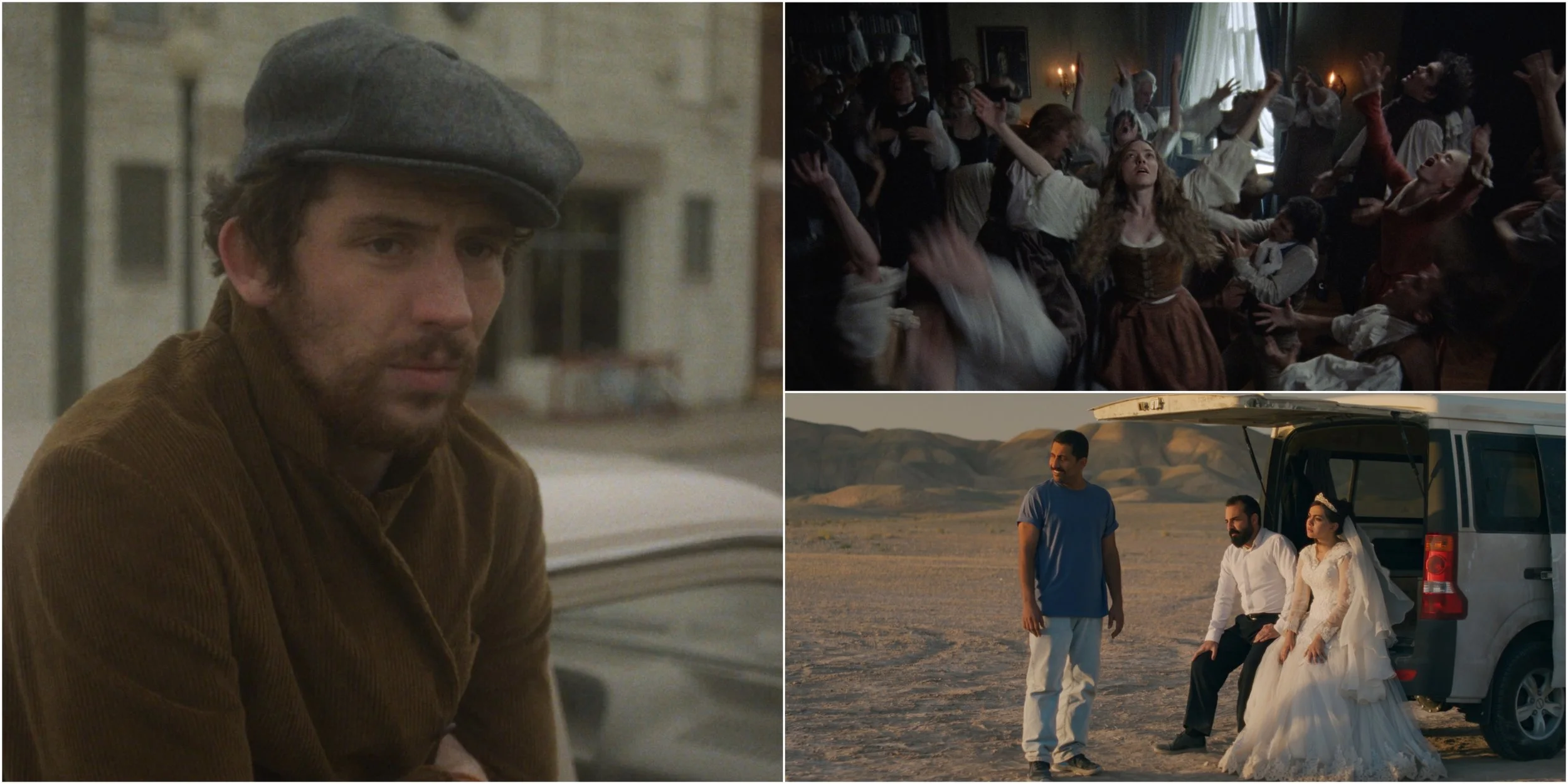
‘The Mastermind’ (MUBI), ‘On Becoming a Guinea Fowl’ (A24), ‘It Was Just an Accident’ (Neon).
2025 has been a hell of a year. Between increasingly tyrannical political leaders, religious/social intolerance, and economic tumult, it feels like nowhere on Earth has been unaffected by the dramatic fluctuations of our current zeitgeist.
Alas, cinema still endures, providing audiences with the ability to (almost) escape the weight of the world for a few hours of salvation in a dark theater, where, for over a hundred years now, movie houses have provided an indiscriminate sanctuary for all strata of society. While the streaming crisis continues to evolve, particularly over the past month as Netflix has battled to secure its hefty acquisition of Warner Bros., few can argue that the theatrical experience still reigns as the supreme environment for watching movies, with popular 2025 releases like Weapons, Sinners, and F1: The Movie serving as box office staples boasting cross-over appeal between critics and the masses. While the future of our planet, and more microscopically, the future of global culture, continues to pose questions about what will come tomorrow, meditations on the past year in cinema persist in offering hope and inspiration. With these reflective sentiments out of the way, let us move on to what we are here for: Foremost Film’s ten favorite films of 2025. Living in a reality shaped by the existential trials mentioned above, our favorite movies of the year are highly reflective of what truly shone and what truly moved us. Without further ado, continue reading to find out Foremost Film’s ten favorites of the year, ranked in ascending order, along with a few honorable mentions and favorite unreleased works:
10. ‘It Was Just an Accident,’ dir. Jafar Panahi
Panahi’s Palme d’Or winner is a culmination of his career to date and a consummation of the immense change happening in his native Iran, a country gradually reckoning with the authoritarianism that has plagued it since the 1979 Islamic Revolution.
A pitch-black comedy, the film’s drama is set in motion by the sound of a squeaking prosthetic limb, which triggers the most traumatic memories for its unlikely hero (and victim), Vahid, played by Vahid Mobasseri. The clever narrative slowly unfolds, tracking a central group bonded by their shared incarceration under the Theocratic regime, all of whom choose different strategies to reconcile with their brutal experiences and have dissenting ideas on taking care of the concern that has drawn them together once more. As the movie follows its intricately drawn characters through the streets and dusty outskirts of Tehran, Panahi’s vision daringly expands far beyond the creative limitations imposed on his earlier work by Iran’s upper echelons of power.
Incited by Panahi’s own experiences of imprisonment and the revolutionary vibrancy of the Woman, Life, Freedom movement, It Was Just an Accident serves as the director’s most daring work yet, and two conspicuous middle fingers to Iran’s authoritarian overlords. Just as the movie is making its way to theaters worldwide, the Iranian government has again slapped Panahi with another prison sentence, for “propaganda activities.” Buy or rent It Was Just an Accident.
9. ‘The Testament of Ann Lee,’ dir. Mona Fastvold
Hot off the awards campaign for partner Brady Corbet’s The Brutalist (which she co-wrote) last year, Fastvold once again returns to the conversation with her latest directorial effort, The Testament of Ann Lee. The film stars Amanda Seyfried in the titular role, the founder of the Shakers, a late-18th-century Christian sect that promoted pacifism, egalitarianism, and celibacy in exchange for the ultimate religious piety.
Shot on 35mm and projected on 70mm for its festival screenings throughout the fall season, The Testament of Ann Lee in many ways mirrors The Brutalist in its explorations of figures hell-bent on uncovering their American dreams, only to have them dashed by the guilded foundations the country was founded upon. The film combines an intoxicating blend of gorgeous period-specific imagery, hypnotic song-and-dance numbers inspired by Shaker traditions, and the story of a woman who refused to be subservient to any man but God. Seyfried delivers her best performance in many years, uplifted by a supporting cast that includes Christopher Abbott and Thomasin McKenzie, the latter of whom can do no wrong in our books. Despite its prolonged runtime (135 minutes) and somewhat cloying depiction of an impossibly zealous, Christ-like female figure, The Testament of Ann Lee flaunts a vibrancy that has stuck with us since we saw it at TIFF. The Testament of Ann Lee begins its theatrical release on Christmas Day, courtesy of Searchlight Pictures. Click here for showtimes near you.
8. ‘Hamnet,’ dir. Chloé Zhao
Adapted from the 2020 novel of the same name by Maggie O’Farrell, Zhao’s latest fictionalizes the domestic life of William Shakespeare and his wife, Agnes, concentrating on the love they share and the tragedy their family faces in the aftermath of their son’s death, which would go on to inform the composition of Shakespeare’s most celebrated play.
Hamnet’s emotional arc guides viewers through themes of life and death, resonating with audiences since its premiere at the Telluride Film Festival. Through the collaboration of Zhao and her creative team, the film avoids the over-polished style of some Shakespearean adaptations, instead presenting images and characters that feel authentic and timeless, in line with Shakespeare’s enduring works. Known for her close collaboration with actors, Zhao elicits potent performances from Jessie Buckley as Agnes and Paul Mescal as Will, ranking among their best work to date. With ideas and images that are sure to pluck your heartstrings, Hamnet emphasizes the importance of love and resilience during the darkest of times. Find showtimes near you, courtesy of Focus Features.
7. ‘If I Had Legs I’d Kick You,’ dir. Mary Bronstein
If, as the film puts it, “time is a series of things to get through,” its core character, Linda, must have a million exhausting days ahead. Just Bronstein’s sophomore feature, her first since Yeast back in 2008, If I Had Legs I’d Kick You is the strangest, yet most visceral, exploration of the tribulations of motherhood among a sea of movies focusing on similar concepts in recent years.
Rose Byrne, at her absolute career best, stars as Linda, a Montauk-based therapist juggling a daughter with complicated health concerns, an absent, uncaring husband (Christian Slater), and a massive hole in the ceiling of her apartment, which the landlords seem fine with ignoring. The movie’s frame remains dizzingly close to Byrne’s face as she toils to make everyone else happy besides herself, with her only breathers coming in the dead of night with a joint in one hand and a bottle of wine in the other. As the movie revolves closer and closer around Linda’s unraveling world, it traverses dynamic territories that range from hilarious to heartbreaking, often within the same scenes.
Since first seeing it at the Berlinale earlier this year (where Byrne won the Best Actor award), If I Had Legs I’d Kick You has remained seared in our minds thanks to its unrelenting singularity, its radical, assaultive structure, and atmosphere. A work certain to produce polarizing reactions, If I Had Legs I’d Kick You is certainly one of the most idiosyncratic films of 2025. Buy or rent If I Had Legs I’d Kick You.
6. ‘Collective Monologue,’ dir. Jessica Sarah Rinland
Shot over five years in Buenos Aires Eco-Park (rebranded from a zoo in 2018) and wildlife sanctuaries near Argentina’s capital, Collective Monologue follows Maca, an animal keeper devoted to the park and its inhabitants. She spends her best moments close to tiny monkeys, macaws, anteaters, flamingos, and other species. The rest of her time is plagued by bureaucratic headaches, notably city funding issues that leave Maca and her team struggling for resources.
Collective Monologue immerses viewers in Maca’s world with simplicity and serenity. Rineland uses eco-park surveillance footage and contrasts it with 16mm handheld film, highlighting the sterility of the former and the tactility of the latter. Rineland’s camera often tracks Maca with the animals, using extreme close-ups to capture tactile contact between the handler and her charges, emphasizing the power of touch, even across species. Sound plays an equally vital role in the documentary's overall sensorial impression. The work downplays the verbal interaction between the park's employees (typically conveyed via radio or voice messages) instead focusing on ambient sounds: the opening and closing of cages, the constant sounds of the surrounding city, the squawks of parrots, and the honks of flamingos. Enigmatic in form but moving in sensation, Collective Monologue stands out as one of 2025’s most mesmerizing documentaries.
5. ‘On Becoming a Guinea Fowl,’ dir. Rungano Nyoni
A fraught chamber piece with splashes of black humor and surrealism, Nyoni's long-awaited follow-up to 2017's I Am Not a Witch certainly does not disappoint, showing the impressive creative progression of the Welsh-Zambian filmmaker's vision. Susan Chardy stars in the film as Shula, a thriving young woman who unexpectedly finds her uncle dead on the side of the road shortly after returning to her hometown in Zambia. As intensive traditions take over the funeral ceremony, Shula must reckon with her uncle's wrongdoings and the unacknowledged effects they have had on her family, specifically its women.
On Becoming a Guinea Fowl speaks enormously to the push and pull between tradition and modernity, family trauma, and gender inequity, building on Nyoni's sensibilities from her early work and further laying the foundation for her as one of our time’s most exciting up-and-coming filmmakers. Originally premiering at the 2024 Cannes Film Festival, where Nyoni was awarded the Best Director prize in Un Certain Regard, On Becoming a Guinea Fowl’s U.S. theatrical release was shamefully fumbled by A24 earlier this year, a distributor that has historically shafted its non-English language acquisitions. Now streaming on HBO Max.
4. ‘The Tale of Silyan’, dir. Tamara Koteveska
For her latest documentary, The Tale of Silyan, which world premiered at this year’s Venice Film Festival, Koteveska builds on the themes of human diaspora and nature conservation introduced in her Oscar-nominated Honeyland, while adding wondrous folkloric flourishes that further link her work to her captivating homeland, Macedonia. Connecting the hardships of a peasant farmer facing a transforming world with those of a popular 17th-century fable about a boy turned into a white stork, The Tale of Silyan is another richly touching feather in Koteveska's cap.
Through its exquisite audiovisual design and humanistic perspective, The Tale of Silyan evokes the timeless beauty of rural life and warns about the consequences that would come if it were left behind, all with a distinctive flair that fully sets the work apart from the harsh realities typically presented in this mode of documentary filmmaking. While cinema has long been preoccupied with capturing humanity’s increasingly fraught relationship with Mother Nature and all her creations, few filmmakers in recent years have so movingly incorporated their own cultures and backgrounds as Koteveska. Find showtimes near you, courtesy of National Geographic Documentary Films.
3. ‘Train Dreams,’ dir. Clint Bentley
Based on the novella of the same name by Denis Johnson, Train Dreams follows the life of Robert Grainier (Joel Edgerton), a simple working-class man who comes to experience all the horrors and beauty of life against the backdrop of a rapidly changing America at the dawn of the 20th century.
Train Dreams works as such an unadorned yet emotionally powerful movie thanks to Edgerton’s superb, possibly career-best performance. Evoking the essence of Robert’s character, as Johnson constructed him, Edgerton is damaged but persevering, lonely but loving, an anonymous face lost to the annals of time, yet an individual who witnesses significant transformation at a crossroads in history —an ultimate reflection of us all. Through its quiet precision, blending brilliant performances, imagery, and storytelling, Train Dreams resonates with a universal power that can leave a lasting impression on any moviegoer this year and the years to come. Now streaming on Netflix.
2. ‘The Mastermind,’ dir. Kelly Reichardt
Since its creation, Reichardt has been treated as a VIP by Foremost Film: her movies have stood out as some of the strongest works of American cinema of the past two decades, yet her penchant for more intimate filmmaking has somewhat alienated her from mainstream success.
Reichardt’s latest, The Mastermind, which premiered at Cannes, feels so warmly familiar yet is a wholly fresh direction for her work. Set in 1970s New England (the director’s first time working outside of the Pacific Northwest since her debut, River of Grass), Josh O’ Connor stars as J.B. Mooney, a rather ordinary father of two who attempts to shake off the banality of his upper-middle-class background by robbing a local gallery’s collection of early Modernist paintings by real-life artist Arthur Dove. What begins as a heist film gradually devolves into a Reichardt staple: a road movie in which no one reaches their final destination.
Awashed in the colors of autumn, beautifully captured with the tactility of 16mm film by the director’s usual collaborator, Christopher Blauvelt, The Mastermind patiently tracks the increasingly bumbling moves of its central character through moments that may feel small, but culminate with an effective portrait of a man lost in the world, unable to engage with the tremendous social change happening around him –– or his own family for that matter –– as he spirals deeper and deeper into the mess he has made of his life. Notably, for the first time in her career, Reichardt approaches the film’s score with zingy vibrancy, working with composer Rob Mazurek to create a rich jazz score that bolsters The Mastermind’s atmosphere and tension. While the film feels nowhere near the durational ordeals of “slow cinema,” The Mastermind does require a certain level of patience for those unattuned to the director’s creative mode, but the ultimate payoff is totally worth it. Stream the film on MUBI.
1. ‘Sirat,’ dir. Óliver Laxe
In one of Sirât’s most overwhelmingly unforgettable moments, a central character dances alone in the never-ending deserts of the Western Sahara, gutturally wailing at the top of their lungs, “BLOW IT UP!” That is precisely what Laxe’s latest movie does: it blows up every expectation of what cinema can be or the feelings it can cultivate as it drives the audience deeper and deeper into the unforgiving topography where its shape-shifting story unfolds. Winner of the Jury Prize at this year’s Cannes Film Festival and recently announced as Spain’s submission for Best International Film at the upcoming 98th Academy Awards, Sirât is nearly indescribable and certainly undefinable, a movie that bores into your brain and pulsates through your body as a wholly ecstatic sensorial experience.
The film follows Spaniards Luis (Sergi López) and Esteban (Bruno Núñez Arjona), a father and his young son, as they struggle to track down their missing daughter and sister, respectively, who was last seen on the illegal rave circuit deep within the deserts of Morocco. Desperate for answers, Luis decides to follow a ragtag group of ravers to another such event farther south, just as a mysterious world conflict initiates far beyond the frontiers of the unforgiving desert that threatens to consume Luis and his newfound escort. As viewers breathlessly track Sirât’s eclectic entourage through increasingly forbidding terrain, Laxe’s immense vision refuses to take its foot off the gas, delivering a film that is utterly singular through both its vibrancy and anguish. Sirât is a cinematic trance, a flawless harmony of audiovisuals and metaphor, and Foremost Film’s favorite movie of 2025. Sirât had an Oscar-qualifying theatrical run in New York City and Los Angeles in November, with plans to expand nationwide in early 2026, courtesy of Neon.
Honorable Mentions
‘Afternoons of Solitude,’ dir. Albert Serra
‘Sinners,’ dir. Ryan Coogler
‘Souleymane's Story,’ dir. Boris Lojkine
‘The Chronology of Water,’ dir. Kristen Stewart
‘The Shrouds,’ dir. David Cronenberg
Favorite Unreleased Films
‘Dreams,’ dir. Michel Franco
‘Islands,’ dir. Jan-Ole Gerster
‘Orphan', dir. László Nemes
‘The Blue Trail,’ dir. Gabriel Mascaro
‘The Love That Remains,’ dir. Hlynur Pálmason