
‘The Plague’ Review: A Kubrickian Study of Teenage Boy Toxicity
Independent Film Company
From Carrie to Heathers to Mean Girls, coming-of-age movies have always held a deep fascination for the cutthroat social pressures that shape the psychology of teenage girls, partially due to misogynistic stereotyping as well as the widespread acceptance that women mature at a faster rate than their male counterparts. As with the films mentioned and countless others over the years, teen girls are often depicted on the silver screen with greater emotional nuance than teenage boys, particularly when exploring their dynamics within same-sex groups.
For his feature directorial debut, The Plague, American filmmaker Charlie Polinger shatters such expectations of teen boys as vacant vessels of hormonal transformation, drawing inspiration from his own upbringing to investigate the unsettling social and biological changes that mold adolescent boys' mindsets, albeit through an uncanny process that parallels male puberty with cinematic traditions of psychological horror.
The Plague stars Everett Blunck as Ben, a twelve-year-old who has just enrolled in a summer session at the Tom Lerner Water Polo Camp after recently relocating from Boston following his mother’s unexpected divorce from his father. Ben becomes fast acquainted with his fellow campers, whose cherubic pre-pubescent faces are betrayed by their razor-sharp perceptibility, which immediately picks up on Ben’s New England accent and spins it into a teasing nickname. The camp is overseen by Daddy Wags (Joel Edgerton, taking a backseat after his incredible performance in Train Dreams), a well-meaning if not bumbling water polo coach whose real struggle for power is shared with camper Jake (Kayo Martin), a wisecracking redhead who really rules the roost.
While Ben works to conceal his inherent sensitivity from the other campers and get into Jake’s good books as the de facto ringleader, another boy, Eli (Kenny Rasmussen channelling Full Metal Jacket’s Private Leonard), makes no attempts to stifle his singularity and probably could not if he tried. Taller, broader, and much pimplier than the other boys, Eli has been excommunicated from the group by Jake and his cronies for having a mysterious “plague,” manifested as the loss of motor skills and eye contact, along with a full-body rash that spreads through physical contact. As the camp days dwindle, Ben becomes caught between his empathy for Eli’s marginalized situation and his own longing to be accepted by the other campers, a conundrum that sends his changing body and mind into a downward spiral of increasingly disturbing turmoil.

Independent Film Company
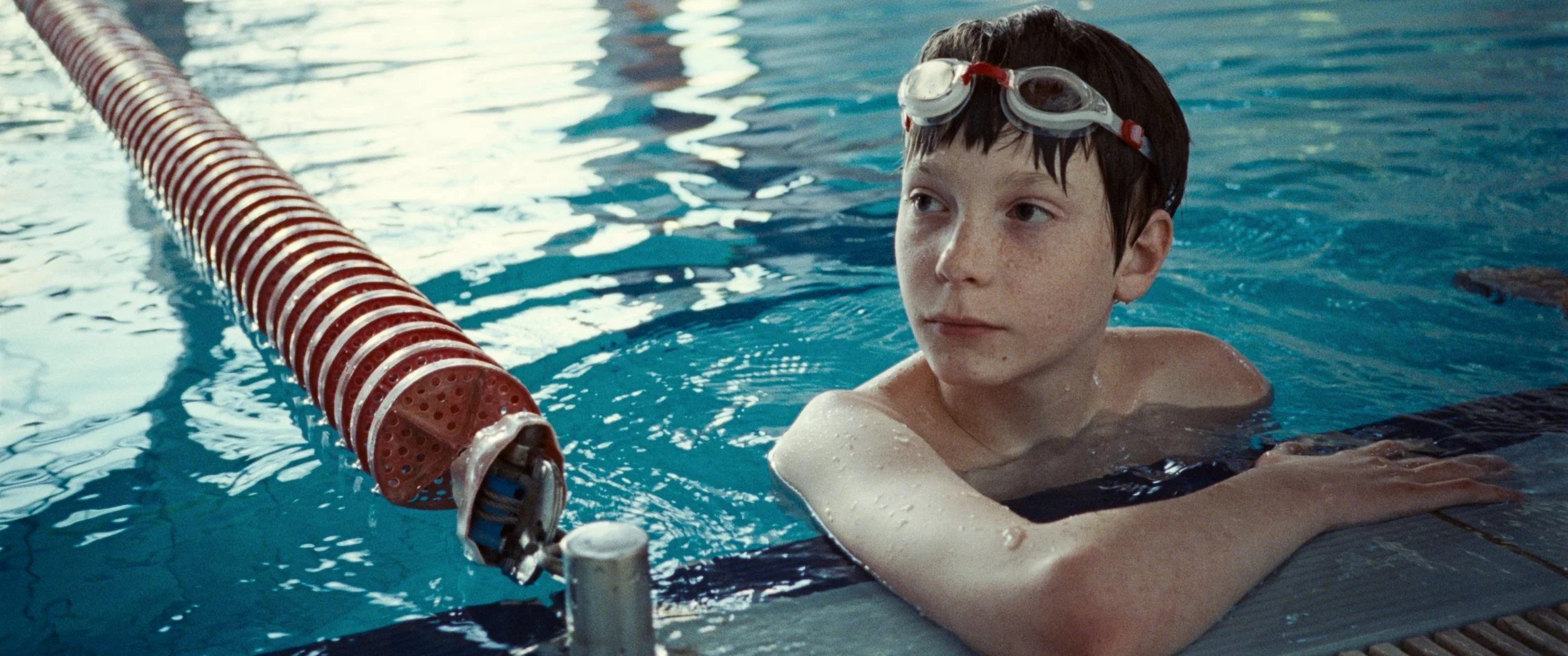
Fueled to write The Plague’s screenplay after revisiting journals from his early teenage years, the mysterious ailment at the center of his debut feature is directly inspired by Pollinger’s own time at water polo camp, during which a boy had been similarly ostracized just as Eli is in the movie. Pollinger expresses his troubled retrospective feelings about the situation through the film’s unrelenting uneasiness, which is powerful enough to entrench the audience in this unstable world of shifting hierarchies and emotions, constantly churning with the threat of unseen riptides, unlike the eerily glassy surfaces of the indoor pools where the boys practice.
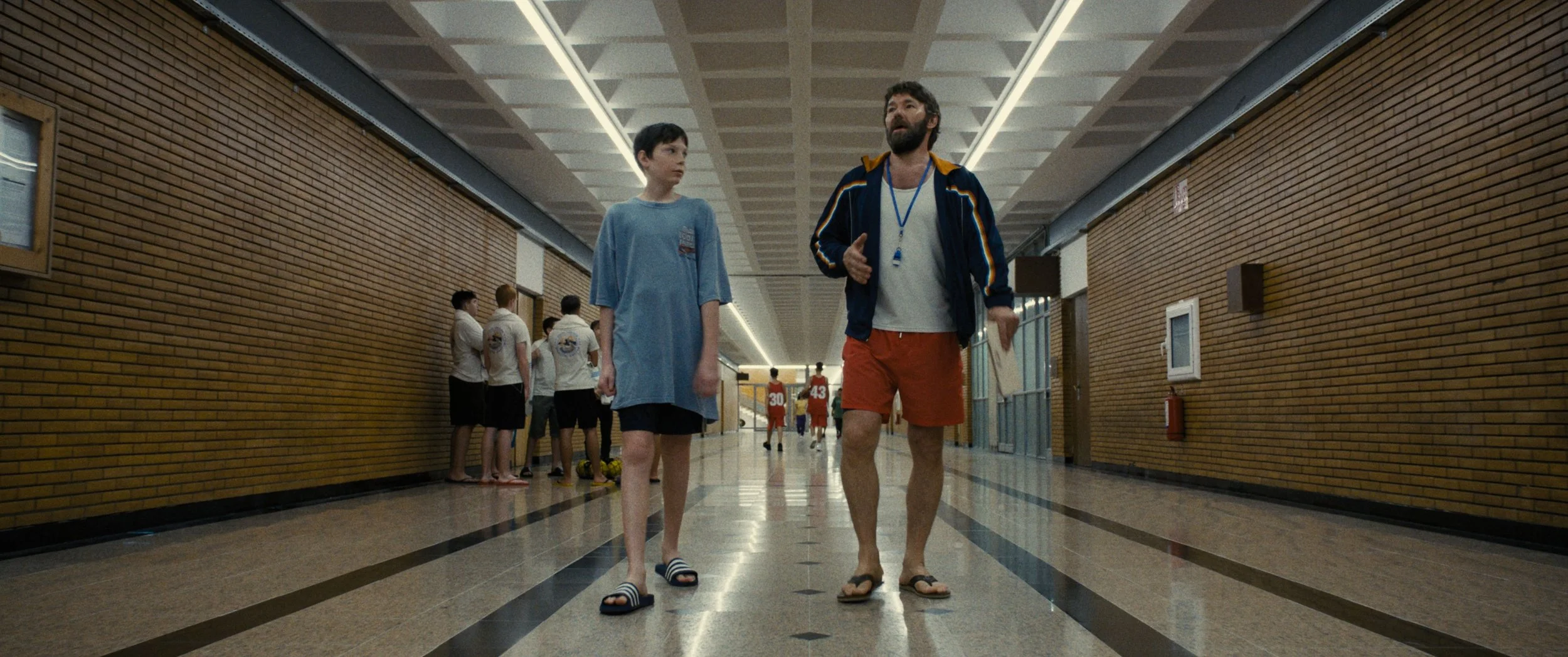
Totally devoid of the warm summer rays that commonly illuminate coming-of-age characters, The Plague is almost wholly awash in the harsh, sterile fluorescent lighting of the lifeless 70s-era community center where most of its drama unfolds. Working with cinematographer Steven Breckon, who shot much of the movie (minus the underwater sequences) on 35mm film, Pollinger exaggerates the Brutalist elements of the community center and incorporates them into the work’s unnerving atmosphere, often framing Ben’s slight figure within expansive wideshots devoid of distractions, emphasizing his increasing isolation. Frequently tracking Ben through labyrinthine hallways that lead him farther and farther into his crumbling psyche, The Plague’s visual references to Kubrickian works like The Shining and Full Metal Jacket could not be more pronounced. The movie only abandons this brilliant formal control during its brief moments of total chaos, when the boys completely let themselves go to the burning rage and emotion they are not yet able to regulate.
Taking place during the summer of 2003, The Plague's setting speaks not only to the director’s own history but also to an era marked by problematic concepts of American masculinity. While the movie’s central figures are growing up in a world that pre-dates the concerns of widespread social media, Ben and his compatriots are entering their teen years months after the outbreak of the Iraq War; they are shaped by a nationalist zeitgeist that upholds Patriot Act ideals of men in the most traditional sense: as strong leaders and protectors. The young men illustrate these influences through often hyper-violent or hyper-sexualized frames of thinking, stretching their young minds far beyond what should be admissible in a contemporary world. Out of all of the boys, Ben seems the one most at odds with these freshly rediscovered models of masculinity, trapped between the disparate privileges of Jake and Eli, unable to belong to either sense of malehood.
Independent Film Company
While some filmmakers may feel more inclined to gradually descend into the treacherous dynamics of a social circle, Pollinger brandishes the unsteady foundation of the campers from the jump, amplifying nerve-shredding scenes that see-saw between reconciliations or standoffs with the slightest modification. Heightened at every turn by a Johan Lenox score that boasts choruses of primordial chanting and panic-inducing string instruments, every encounter Ben experiences threatens to plunge into ceremonial humiliation at the hands of the other boys. This unrelenting defensiveness with which the boys must move spares no embarrassment, whether that be unexpected erections or sauna-induced rashes. During its most uncomfortable junctures, the film once more references its idols, the locker room infamy of Carrie and the “blanket party” from Full Metal Jacket, punctuating some of the campers’ most poisonous moments.
Singular in its hauntingly atmospheric descent into the minds of boys on the cusp of adolescence, The Plague is a formally immaculate debut from Pollinger, who mines his own memory to create a visceral cinematic experience hard to forget, despite the at times schematic beats of its narrative. A filmmaker definitely on the rise, Pollinger has already signed on for his second film, an adaptation of Masque of the Red Death, to be produced by A24.
4/5
2025 | Romania, USA | 95 min | Color | English
‘The Plague’ premiered in Un Certain Regard at the 2025 Cannes Film Festival. The film begins its limited theatrical release in the United States on December 24 before expanding in the following weeks, courtesy of Independent Film Company. Click here to find ‘The Plague’ showtimes near you.