
Kino Lorber
In the eighty-plus years since its conclusion, no global conflict has been more broadly represented in cinema than the Second World War: its comprehensively transformative influence on international relations, territorial borders, and social structures continues to impact filmmakers and their work today, from Hollywood blockbusters to film festival standouts. While history buffs may be excited about the announcement of another World War II film, many others bristle with trepidation, as the oversaturation of this conflict in period cinema often feels overdone, failing to showcase unexplored perspectives or ideas (2025’s handsomely crafted but boringly conventional Nuremberg comes to mind).
For the first time in his well-established career, German-Turkish filmmaker Fatih Akin tackles the formidable subject of World War II with Amrum, a rather surprising move from an auteur whose work typically focuses on the cultural friction of his personal heritage. Onboarded to direct the film by German actor, director, and mentor to Akin, Hark Bohm, who drew inspiration for the screenplay from memories of his upbringing in the final days of World War II, Amrum operates as a well-executed coming-of-age film in the tradition of post-war neorealist works like Bicycle Thieves or Germany, Year Zero, albiet with much more lavish cinematic flare.
Named after the North Sea island where the film unfolds, Amrum’s setting feels like a place out of time, where multi-generational families still live off the land and the encircling ocean, a world controlled by the winds that blow in from the water, and the intermittent sun far overhead. In the spring of 1945, one of the only features to interrupt Amrum’s never-ending prairie vistas were Nazi flags, waving high in the sky like bold red beacons.
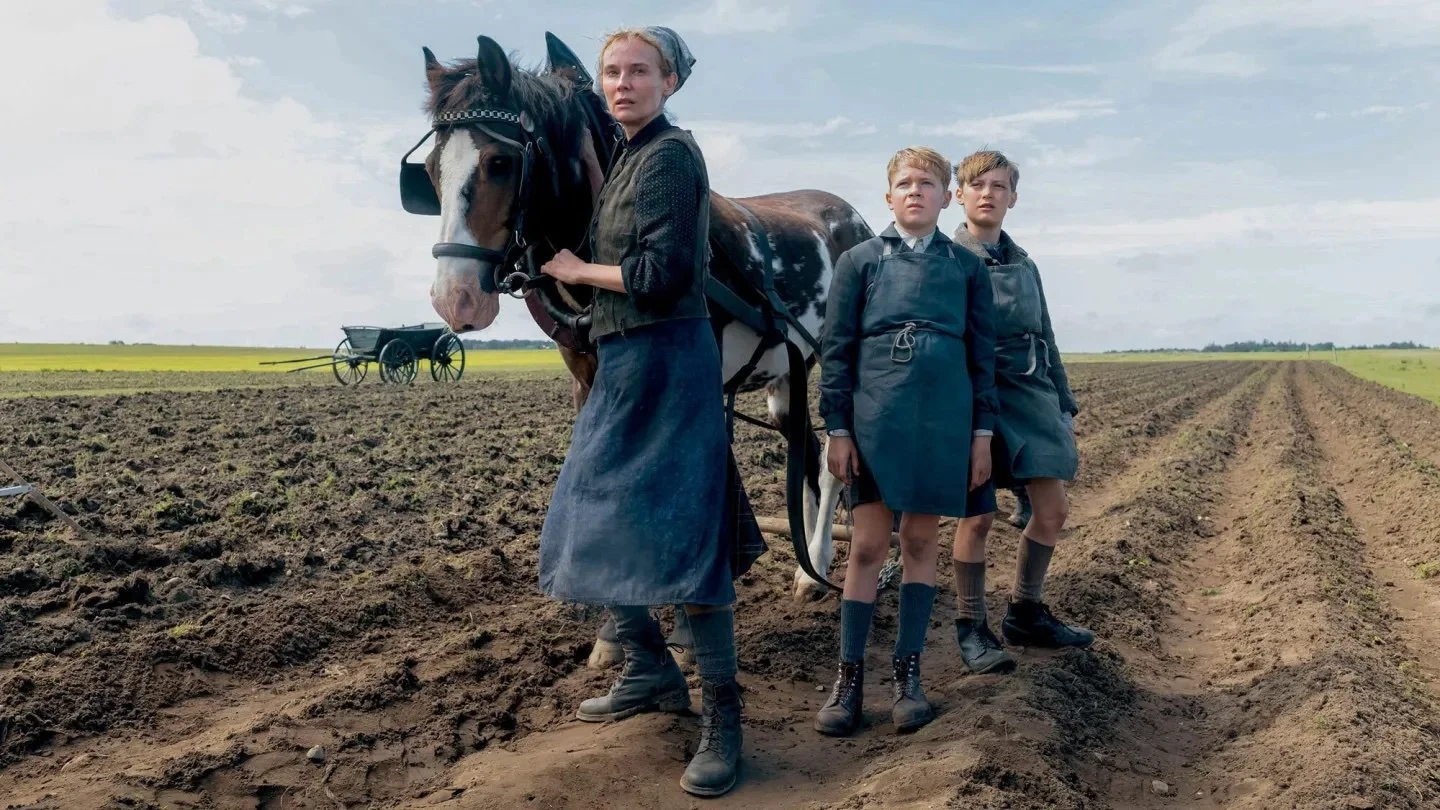
One of these banners proudly stands outside the home of twelve-year-old Nanning Bohm (Jasper Billerbeck in his acting debut), whose ancestors have hailed from Amrum for nine generations. The oldest of his siblings, Nanning bears responsibility for his large family, particularly since his father, “a Nazi bigshot,” is off fighting for Hitler’s mission of German superiority. Although Amrum feels far removed from the war-torn streets of Europe’s capitals, the community is starting to feel the pressure as goods become harder to obtain and ethnically German refugees flood in from the East. Local farming leader Tessa (an almost unrecognizable Diane Kruger) cannot contain her anticipation for Hitler’s looming downfall, much to the disapproval of Nanning’s mother (Laura Tonke), who still fervently supports the Führer, even though “the Russians are fifty kilometers from Berlin.”
Everything changes for Nanning, his community, and all of those impacted by the war on April 30, when word of Hitler’s suicide is broadcast to the world, unexpected news that sends the boy’s mother into labor, followed by a sinking depression that leaves her unable to tend her brood, still clinging to Hitler’s eternal promises of “white bread with butter and honey.” Caught up in this unstable world, shocked by the war’s devastation, the precocious Nanning shoulders the weight of his mother’s wish, hoping that its fulfillment will somehow cure her despondency. On his bootless errand, Nanning comes to better comprehend the zeitgeist’s tumult in which he is forced to face the future of a forever changed Germany.

Kino Lorber
Although its narrative beats follow many of the standard routines of coming-of-age post-war cinema, Amrum differs from many of its spiritual predecessors in how it depicts its environment as a rustic sanctuary for its characters. Far away from the bombing destruction of cities like Berlin or London, Nanning and his family (who retreat to Amrum when Hamburg is attacked) live with safety and tranquility unafforded to the urban figures of Rossellini’s Neorealist films. Amrum’s connection to place is further bolstered by Bohm’s screenplay and the childhood memories that bleed into it.
Akin’s responsibility to honor his mentor’s ties to the island is present in every scene of Amrum, most of which are framed by an appraisal of the natural world reminiscent of German Romanticism. Cinematographer Karl Walter Lindenlaub captures the wind-rippled seagrass, the starry night skies, and the gentle ebb and flow of the tides, making the island feel like Nanning’s boundless playground, the exact type of place that would leave an indelible impression on any child’s memory.
Amrum’s portrayal of this seaside utopia never ignores the wartime crises that press upon its community, especially as Nanning’s character is increasingly confronted by them. Like a small microcosm representative of many other parts of Hitler’s domain in 1945, suspicion and fear seep into the farming society, with Nanning’s mother serving as a potent reactionary through her Nazi zeal, an unredeemable enthusiasm that not only wears on her family but also the rest of the village, particularly as she refuses to accept the downfall of the Third Reich’s regime.
Partly due to his mother’s self-imposed isolation and his birth in distant Hamburg, Nanning is often referred to as a “mainlander” by the residents of Amrum, even though his ancestral roots are deeply linked to the island. This otherness that Nanning faces not only reflects his adolescent concerns about fitting in but also intriguingly challenges the era’s typical notions of cooperative German nationalism.

Kino Lorber
While Amrum’s tale of a young lad pushed into manhood by wartime hardships has been explored time and again throughout cinematic history, it is rarely examined from a German perspective (especially in U.S.-released films), which is one of the work’s greatest strengths. Similar depictions, especially the contemporary ones, too often wittle the nuances of the Second World War down to “good versus evil,” but Amrum’s screenplay offers rich complexity at every turn, all while commemorating Bohm’s lived experience, especially pertinent as accounts from World War II disappear into the annals of history with the passage of time. Released in Germany just a month before Bohm’s death, Amrum has already proved one of Akin’s most successful commercial releases to-date.
3.5/5
93 minutes | Coming-of-Age | Germany | German with English subtitles | 2025
‘Amrum’ world premiered at the 2025 Cannes Film Festival. The film begins its U.S. theatrical release on Friday, April 17, courtesy of Kino Lorber. Click here for ‘Amrum’ showtimes near you.